Base phosphorus and potassium: forms, balance and placement
Potato tubers remove about 5.8 kg K₂O per tonne, according to the PDA — but multiplying yield by that figure gives offtake, not a fertilizer rate.
Potato Nutrition series · Part 03 of 24 · All parts in order
Phosphorus moves little in soil, and the potato root system is relatively limited. Its availability in the young root zone is therefore often more important than the formal amount per hectare. The UK Potash Development Association (PDA) explains that phosphate recommendations for potatoes are significantly higher than crop offtake, while potassium demand is especially high during active growth and bulking.
The PDA's March 2026 overview gives a reference point for the balance: tubers contain around 5.8 kg K₂O per tonne. So 40 t/ha means roughly 232 kg K₂O/ha removed, and 70 t/ha about 406 kg. This is an offtake calculation, not a fertilizer rate: part of the K comes from the soil, and the maximum K accumulated by the crop exceeds what the tubers remove. A rate cannot be obtained by simply multiplying yield by a coefficient.
В будние дни. Отписаться можно одним щелчком мыши.
Calculation with the PDA coefficient: 5.8 kg K₂O per tonne of tubers
K₂O removed by tubers, kg/ha. This is offtake, not a fertilizer rate.
The source of potassium also matters. In Ireland, Teagasc stresses that for some processing purposes sulphate forms can maintain dry matter better than chloride; but excess potassium of any form can also reduce dry matter. The chloride form is not banned in principle: the choice depends on timing, soil and contract requirements for the tubers.
Geography and practical application
British and Irish recommendations work as a calculation method for a humid temperate climate; low-K fields in Eastern Europe need their own diagnosis. On the irrigated sands of Idaho, special attention goes to the K accumulation phase and monitoring.
Agronomic guidance here is general practice; agree rates and timing with your agronomist.
Partner material: Uralchem products — conditional selection
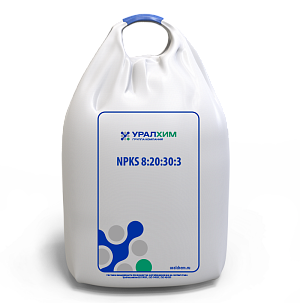 NPKS 8:20:30:3
For base or banded application, Uralchem's granular NPKS 8:20:30:3 can be considered: according to the catalogue it contains 8% N (ammonium form), 20% P₂O₅, 30% K₂O and 3% S. The rate is calculated from soil analysis and the balance of all nutrient sources; a brand name does not replace a field calculation.
Изображения продуктов: Uralchem.
Not a rate recommendation — consult your agronomist.