
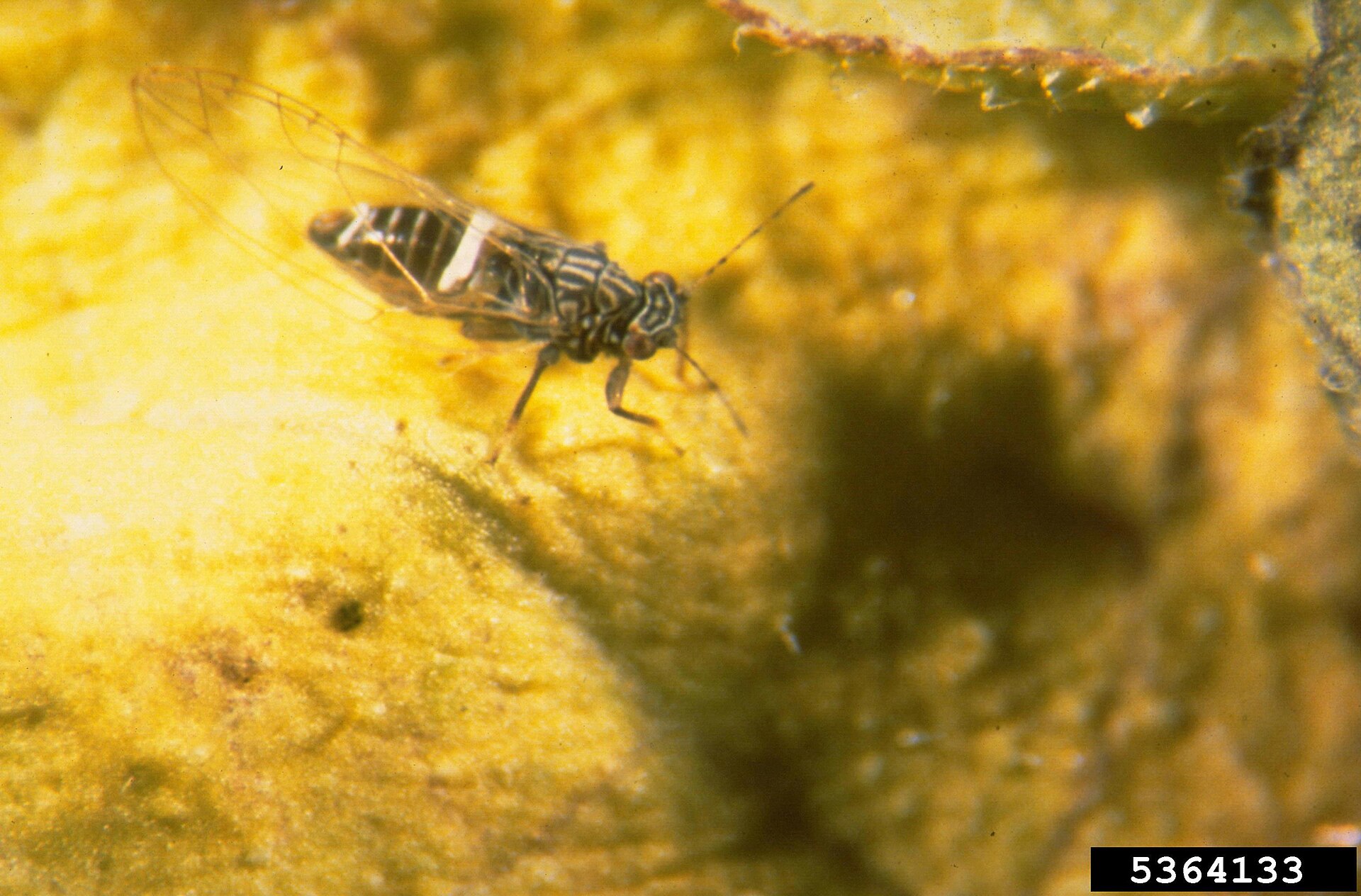
Zebra chip is the newest major disease on the world potato map — first recognized in the 1990s in Mexico and Texas, and named for the dark stripes that appear in fried chips and crisps. The cause is a bacterium, Candidatus Liberibacter solanacearum, which cannot survive on its own: it lives inside the potato psyllid (Bactericera cockerelli), an insect the size of an aphid, and spreads only as the psyllid feeds and moves.
Foliar symptoms are maddeningly variable: leaf scorching, chlorosis, swollen nodes, aerial tubers, collapsed stolons and wilted canopies that can mimic late blight, psyllid damage or nutrient stress. Some infected plants show almost nothing above ground. The reliable signature is underground: fried or roasted slices of affected tubers develop dark, caramelized stripes and blotches that make the product unsaleable — the defect that gives the disease its name and its economic force. Fresh-table potatoes may show only internal discoloration, but processing rejections at fry tests are how most outbreaks are first caught.
The vector is the key to everything about this disease. Potato psyllids overwinter on solanaceous weeds and volunteer potatoes, migrate into crops in spring and summer, and transmit the bacterium while feeding; nymphs can also pass it to their offspring. Warm, dry conditions favor psyllid build-up, and the insect moves on wind over considerable distances — which is why zebra chip appears in fields far from the obvious source. Liberibacter itself does not persist in soil or debris; remove the psyllid and the disease cycle stops.
That vector dependence also defines management. Insecticide programmes targeting psyllids — starting early, before populations establish, and covering the migration windows — are the primary tool in affected regions such as the southwestern United States, Mexico, New Zealand and parts of Central America. Systemic and contact products are rotated to avoid resistance; thresholds and degree-day models guide timing. Where the psyllid is present but Liberibacter is not yet established, vector monitoring is a biosecurity duty: sticky traps and regular field sweeps decide whether the season becomes a spraying season.
Clean seed remains essential, because the bacterium can also be carried in infected tubers, and rogueing symptomatic plants reduces inoculum within a field. There is no curative treatment for an infected plant, and no commercial variety with durable resistance, although differences in tolerance are used in breeding programmes in New Zealand and the US.
Zebra chip matters to every potato region beyond its current range for one reason: it travels in a tiny insect on wind currents, and its first appearance is usually detected by a fry test, not by a field scout. Processing buyers in new regions increasingly ask about psyllid monitoring — a question that would have been meaningless a decade ago.