
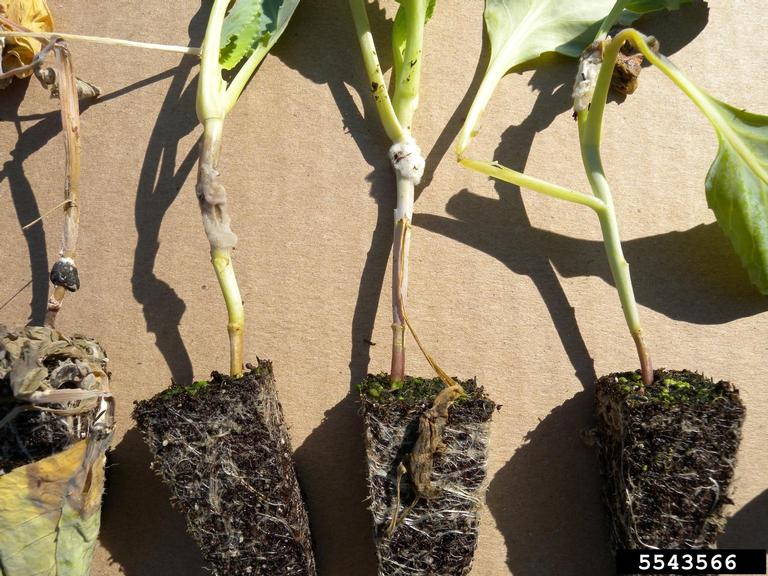
White mold, caused by Sclerotinia sclerotiorum, is the potato disease that arrives from another crop’s rotation: a broad-host fungus whose hard black resting bodies — sclerotia — survive in soil for years and germinate to infect potato stems when moisture and canopy closure coincide. Beans, sunflowers, canola, carrots and many vegetables all leave sclerotia in soil, so the disease is a rotation memory as much as a potato problem.
The characteristic field sign is a watery, pale-green to straw wilting of individual stems or patches, with a white, cottony mycelium on the lower stem at the soil line. Press the white growth and the stem interior shows black sclerotia forming inside the pith — small, irregular, rat-dropping-like bodies that are the disease’s time capsule. Affected stems shred and collapse, and in humid seasons the white mold climbs the plant and flowers, coating them with mycelium and sclerotia that fall back to the soil. Direct yield loss is usually patchy, but the patches carry forward: every sclerotium is a future outbreak.
In storage, white mold matters through tuber infection at harvest: sclerotia and mycelium contaminate lifting equipment and soil, and infected tubers develop a soft, watery rot with white mycelium — indistinguishable in the box from other wet rots until the black sclerotia appear. Contaminated tubers moving through a store or packing line spread the fungus to surfaces and boxes, which is how a field patch becomes a facility problem.
The fungus is favored by cool, wet soil at flowering and early bulking, by dense canopies that stay wet, and by rotations close to susceptible broadleaf crops. Because sclerotia germinate in response to soil moisture and then infect through senescing tissue — fallen petals and aging lower leaves are the usual entry — the disease pressure window is specific: wet weather in the month after row closure, in a field with a susceptible-rotation history.
Management is rotational and cultural, with fungicides as a targeted supplement. Extending the interval since beans, sunflower or canola is the strongest lever — sclerotial density declines with time and with non-host crops. In crop, canopy management that speeds drying (spacing, timely haulm kill, avoiding over-irrigation) reduces the wet-stem hours the fungus needs; fungicides exist for high-risk situations and are timed to the susceptible window rather than used season-long. Deep burial of sclerotia by inversion tillage delays their return to the germination zone.
White mold rarely drives a whole-season programme the way late blight does; instead, it collects debts from rotation decisions made years earlier. For growers, the practical habit is remembering which fields have carried beans and sunflowers — and treating those fields’ potato years with extra respect for wet weather in July and August.