
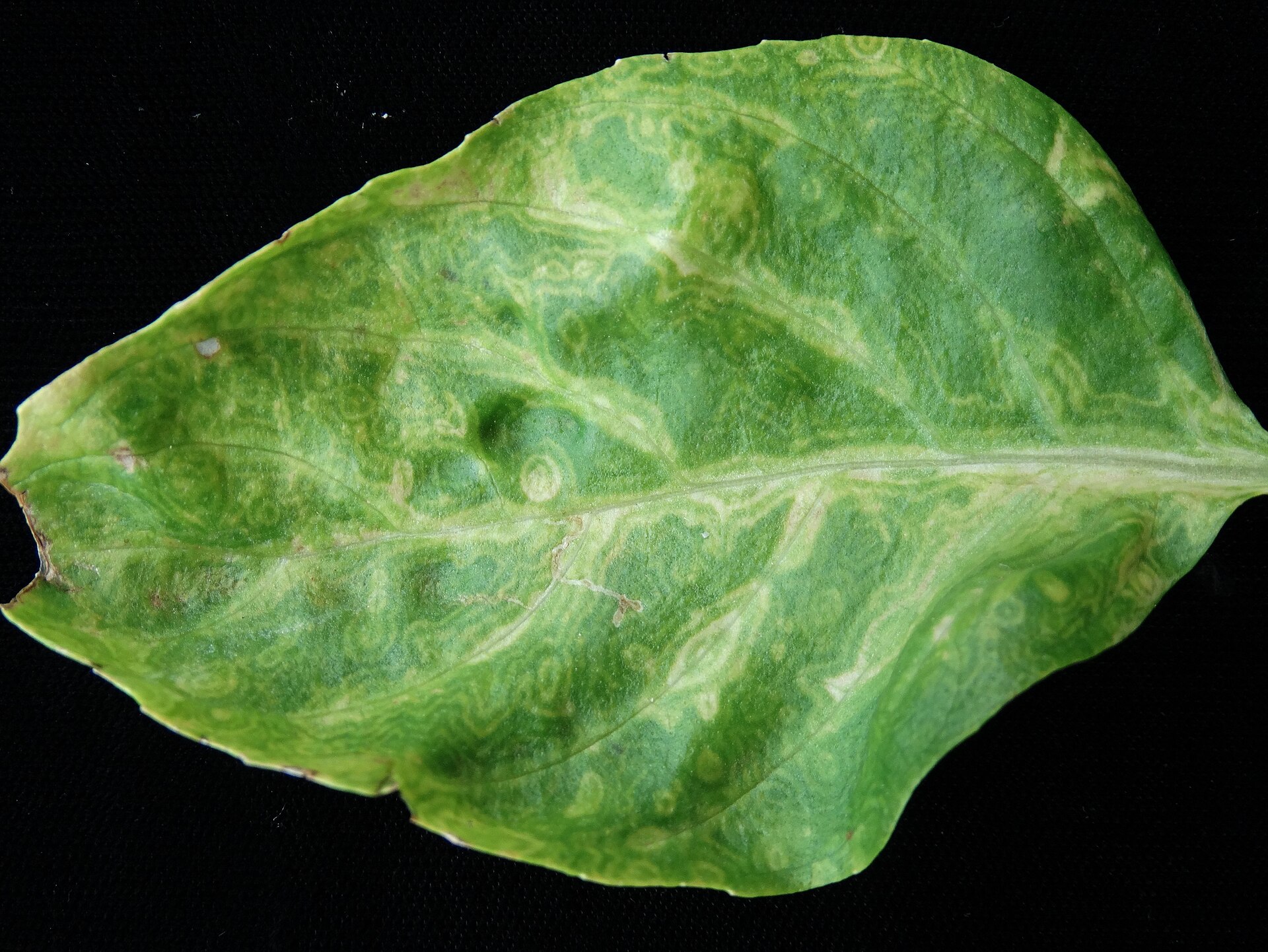
Tomato spotted wilt virus (TSWV) is a generalist plant virus that occasionally hits potato hard: thrips-transmitted, host-range enormous, and capable of causing a wilt-mosaic-necrosis syndrome in susceptible varieties that can be confused with late blight, early dying or herbicide damage. In potato it is primarily a problem of warm seasons, greenhouse-adjacent production and regions where thrips populations build on vegetable and ornamental crops.
Symptoms in potato are frustratingly diverse: bronzing and upward rolling of the top leaves, purple-brown necrotic streaks on stems, stunting, and in severe infections a rapid wilt that collapses young plants. Some varieties react with concentric ring spots on leaves; others show almost nothing above ground while tubers develop internal arcs of necrosis — spraing-like markings that lead to rejection at processing tests. The range of expressions means TSWV is often confirmed by laboratory test after the field diagnosis has cycled through two or three alternatives.
The vector is the key: thrips — chiefly western flower thrips (Frankliniella occidentalis) and onion thrips (Thrips tabaci) — acquire the virus only as larvae, then carry it for life and transmit as adults feeding. Because acquisition happens in the larval stage on infected hosts, the crop’s risk tracks what thrips were feeding on before potato: infected ornamentals, vegetable transplants, weeds and greenhouse crops all seed the local vector population. Thrips are weak fliers, so outbreaks are local and patchy, often starting near greenhouses, transplant beds or weedy headlands.
Management starts before planting with vector hygiene: weed control around the field and on margins, distance from greenhouses and susceptible crops where feasible, and thrips monitoring with sticky traps or flower-tapping to time any intervention. Insecticides can suppress adult thrips but do not reliably prevent transmission, because even low surviving populations transmit; the more consistent returns come from reducing the reservoir — clean transplants, managed weed hosts, and crop isolation. Rogueing symptomatic plants early reduces inoculum in seed and ware fields alike.
Resistance exists and works: the Sw-5 gene, bred from wild tomato into potato lines and varieties in several breeding programmes, gives strong resistance to TSWV and is the decisive tool where the virus is recurrent. For regions where TSWV is occasional rather than endemic, the practical posture is vigilance: know the thrips season, know the neighbouring crops, and test anything that looks like a wilt the sprays should have cured.
TSWV rarely defines a potato season the way late blight does — but in a thrips year, in a susceptible variety, beside a greenhouse, it can take a field from ordinary to unmarketable between two scouting rounds. It is a disease whose management is mostly done by other people’s crop hygiene, which is why the growers who track their neighbourhood’s vegetables and ornamentals sleep better in August.