
The potato cyst nematodes — the golden nematode (Globodera rostochiensis) and the white potato cyst nematode (G. pallida) — are the most damaging nematode pests of potato worldwide and quarantine organisms in the European Union, the Eurasian Economic Union, North America and beyond. They are called cyst nematodes for the female’s transformation at the end of her life into a tough, lemon-shaped cyst packed with 300–600 eggs — a survival capsule that protects the next generation in soil for up to thirty years.
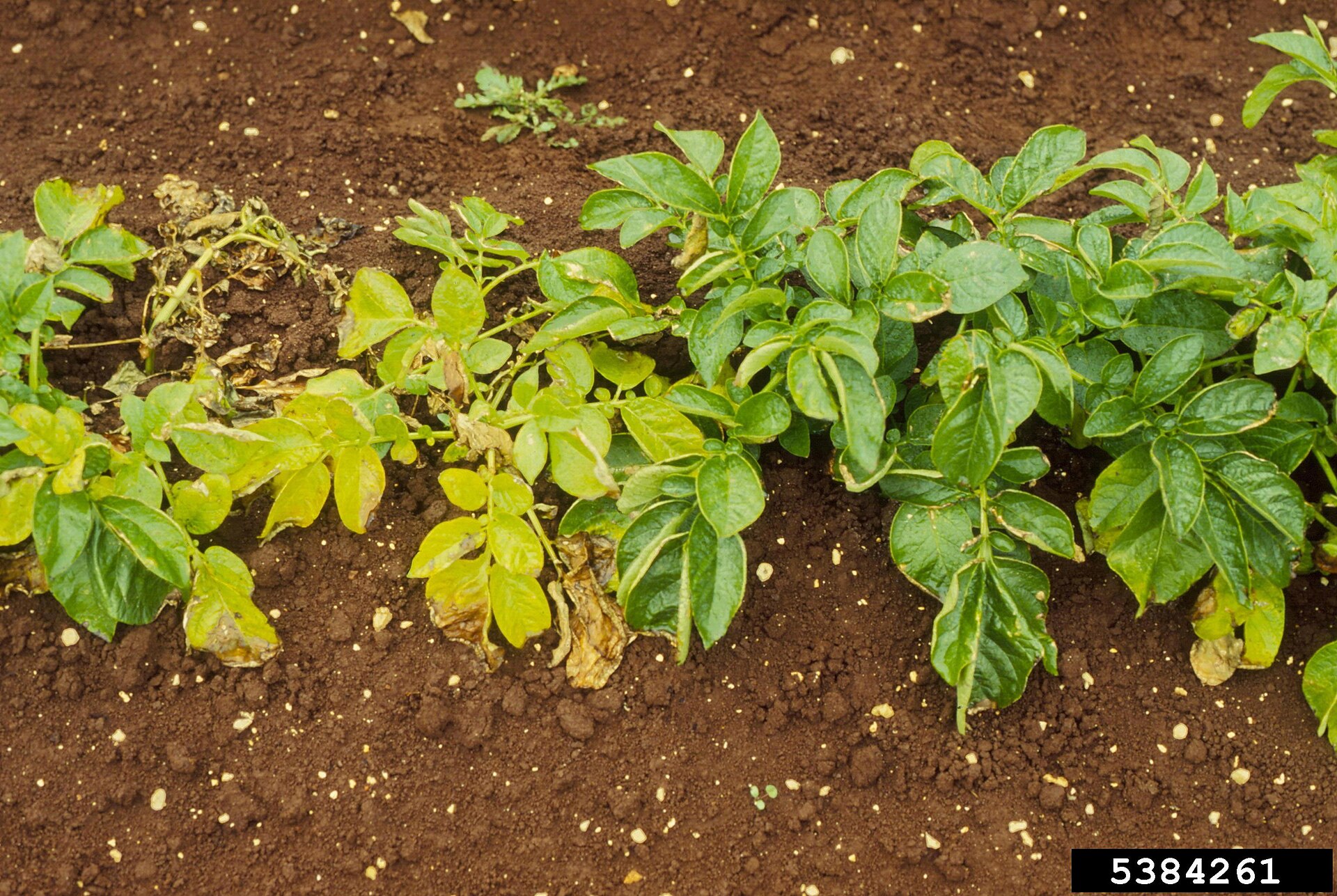
The damage is invisible from the road. Juveniles hatch in response to substances diffusing from potato roots, penetrate the root, and set up permanent feeding sites that drain the plant’s nutrients into a syncytium — a living tap the nematode drinks from for life. Infested plants show the classic nematode signature: patches of poor growth, early senescence, wilt under stress despite adequate water, and a canopy that looks like nitrogen deficiency but does not respond to fertilizer. Root systems are stunted and the fine feeder roots are gone; digging reveals pinhead-sized white, then yellow (rostochiensis) or white (pallida) females attached to the roots, visible with the naked eye at high infestation.
Yield loss scales with initial population: at low densities the crop loses a few percent; at high densities, fields produce a fraction of their potential, and the patchy pattern of infested fields makes the loss look like soil variation until a soil assay proves otherwise. The cysts move between farms with soil — on machinery, footwear, seed tubers, wind-blown dust and surface water — which is why both species have statutory distribution maps and why an infested field designation changes a farm’s machinery logistics for decades.
Control has three working pillars. The first is resistance: major-gene resistance from wild Solanum species (the H1 gene against G. rostochiensis, and quantitative resistance against pallida) is deployed in a large share of European and North American varieties, and resistant varieties are the backbone of control on infested land — with the standard caution that resistance genes select for virulent pathotypes, so their longevity depends on rotations and, where regulations require, structured gene deployment. The second pillar is rotation: because juveniles hatch only in response to potato-root signals, years away from potato starve the population steadily; seven years or more between potato crops is the classical recommendation for heavily infested ground, and even long rotations only suppress, never eradicate. The third pillar is nematicides and biologicals, which protect high-value crops on lighter infestations where rotation alone cannot carry the risk.
For clean regions, the perimeter is hygiene and monitoring: soil testing before renting or buying land, machinery cleaning between farms, and immediate reporting of suspect patches. For infested regions, the discipline is integrating all three pillars — variety choice first, rotation second, chemistry third — because each alone fails within a few seasons. For the industry, these nematodes are the reason potato has a phytosanitary passport system at all: the cyst in the soil outlives the memory of the field where it was found.