
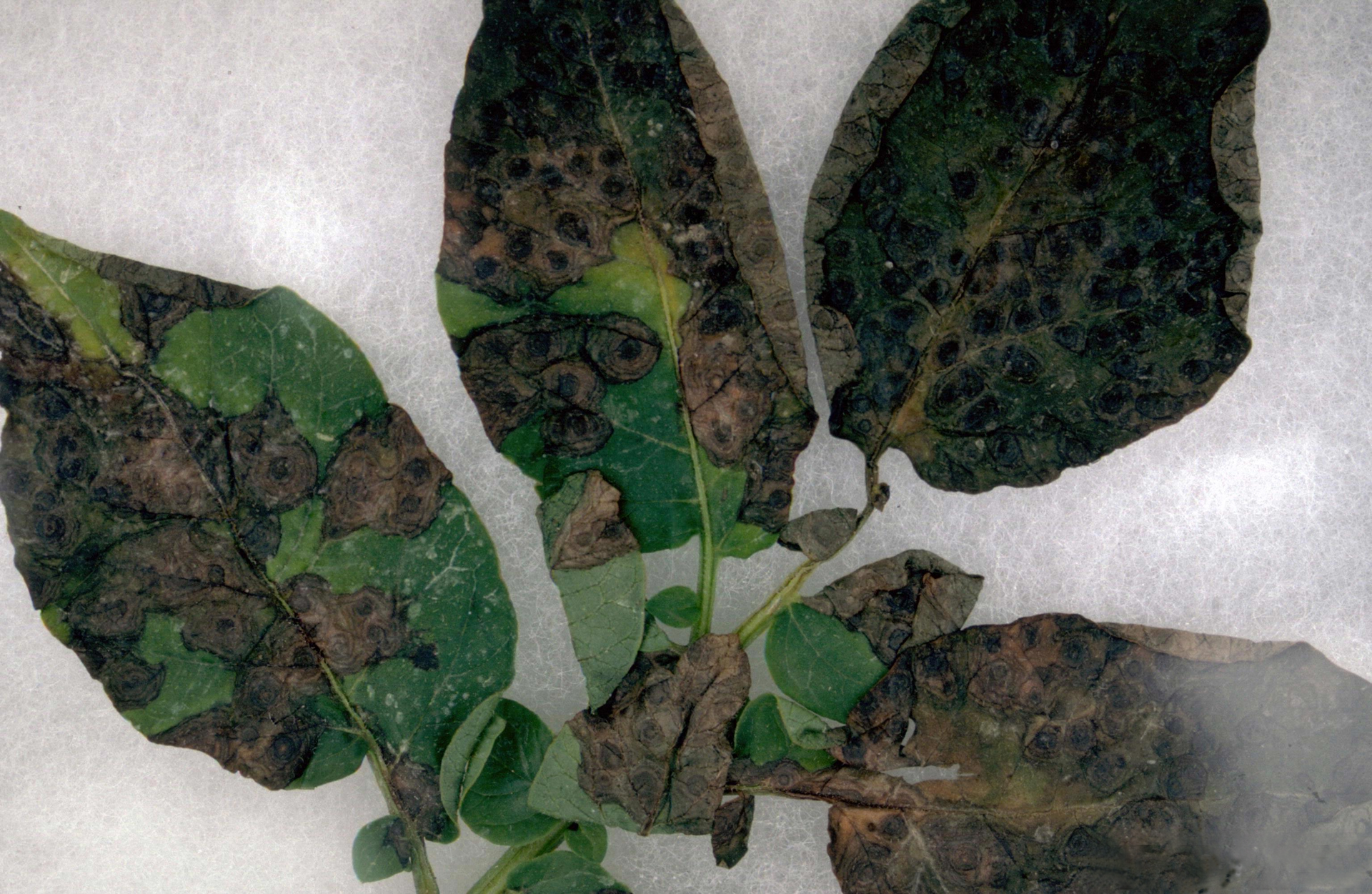
Brown spot, caused mainly by Alternaria alternata, is the frequent companion of early blight and the disease that often fills the gap when a season turns hot and dry. Where early blight (A. solani) is associated with senescing, stressed canopies, brown spot can attack green, actively growing tissue when conditions turn unfavorable — heat waves, drought stress, ozone injury or potassium deficiency all lower the leaf’s defences and open the door.
The symptoms are easy to confuse with early blight at a glance, which matters for spray decisions. Brown spot lesions are typically smaller and more numerous than early-blight target spots, with finer concentric zoning and a sharper yellow halo; under severe pressure they pepper the leaf so densely that tissue yellows and dies between the spots, giving the canopy a scorched look that can be mistaken for chemical burn or fertilizer damage. A hand lens helps: A. alternata lesions develop a dark, velvety sporulation in their centres under humid nights.
On tubers, brown spot is one of the causes of black pit — sunken, dark, pimple-like lesions with raised borders, most often at the stolon attachment. Black pit is cosmetic rather than rotting, but heavily affected lots are downgraded or rejected in fresh markets, and the same wound sites invite soft-rot bacteria in store.
The pathogen is a weak parasite with an extremely wide host range — it survives in soil and debris on many crops and weeds, which makes rotation a weaker tool against brown spot than against early blight. What it cannot tolerate is a well-fed, unstressed canopy: the practical levers are potassium and nitrogen balance, consistent irrigation through heat periods, and avoiding the leaf damage that follows careless herbicide or fertilizer application.
Fungicide programmes effective against early blight generally cover brown spot as well — the same protectant backbone of chlorothalonil or mancozeb, supplemented with azoles, SDHIs or strobilurins in mixture during high-risk windows. Because pressure builds fastest when the canopy is stressed, the highest-value sprays are those applied ahead of forecast heat and drought, not after the damage is visible.
Brown spot is rarely a headline disease, but in Mediterranean, Central Asian and other continental climates with hot summers it routinely costs more than late blight in sprayed programmes — precisely because it thrives in the weather that growers hope will keep late blight away. Scouting during heat waves, not after them, is the habit that pays.